Ready-made products for your natural routine..
Do you want to stay updated on offers, (giveaway) actions and recommendations? This way you won't miss out on anything! Not too often, we promise.


They have the word "oil" in common, but are very different. Both come from plants, seeds and fruits and bring special skin properties with them. What are the differences between these oils? And how are they used?
You may have heard it in natural cosmetics circles or read it on our website. A carrier oil, or in English Carrier Oil. But what is it actually?
In short, a carrier oil is a fixed oil. They are called "fixed" because they do not evaporate and stay on the skin. Plant-based oils are also called carrier oils in natural cosmetics because they are used to "carry" other elements in an end product. In other words, an essential oil that is combined with a carrier oil will be absorbed by the skin better than an essential oil on its own.

It is very understandable that these two get mixed up, since both have the word oil in them. The difference is actually very simple. Carrier oils are fixed, and essential oils are volatile oils. In other words: fixed oils stay on the skin and essential oils evaporate. Simple, right?

Experiment: Put a drop of essential oil on the palm of one hand and a drop of olive oil on the palm of your other hand. Do you see the difference? Do you feel the difference?
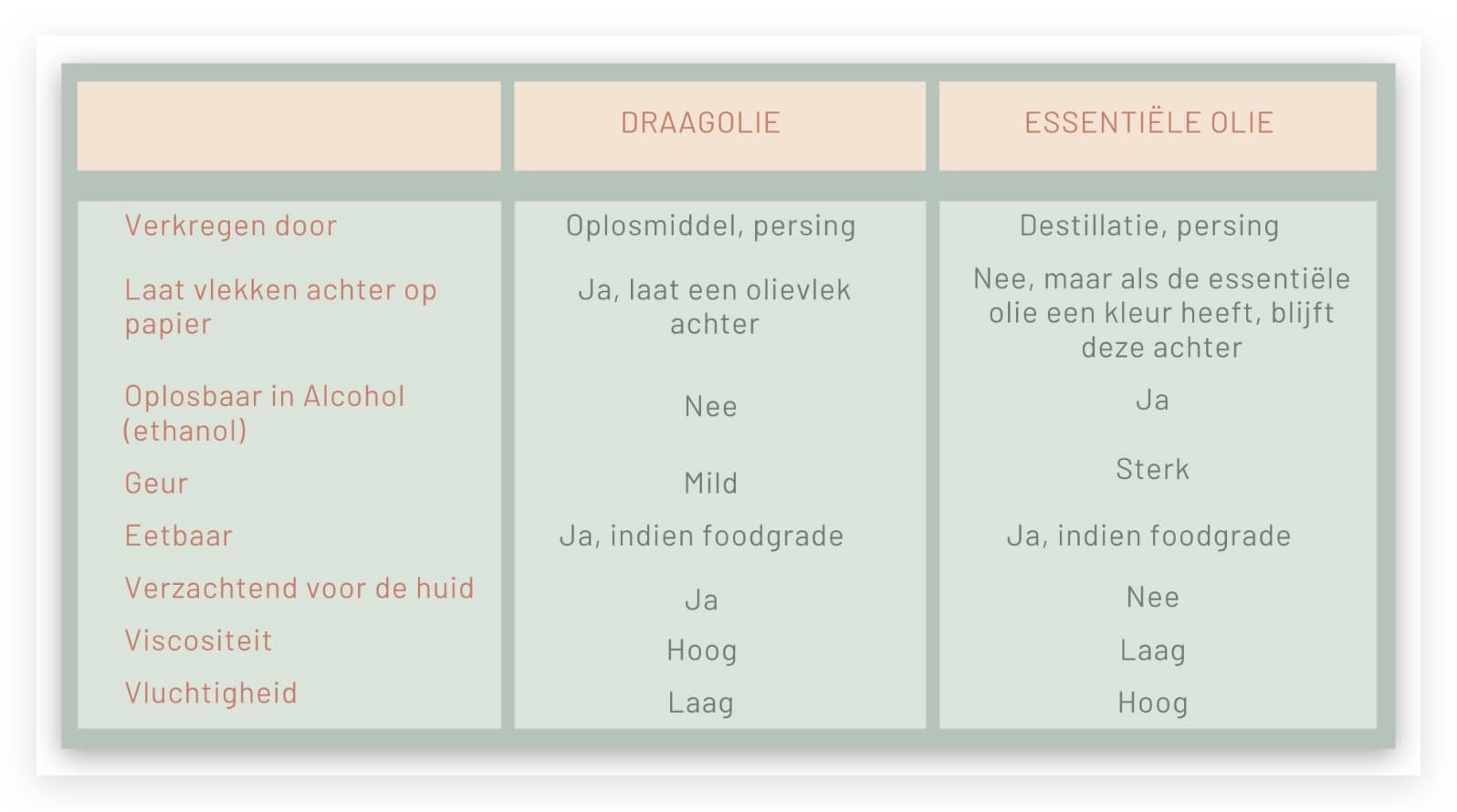
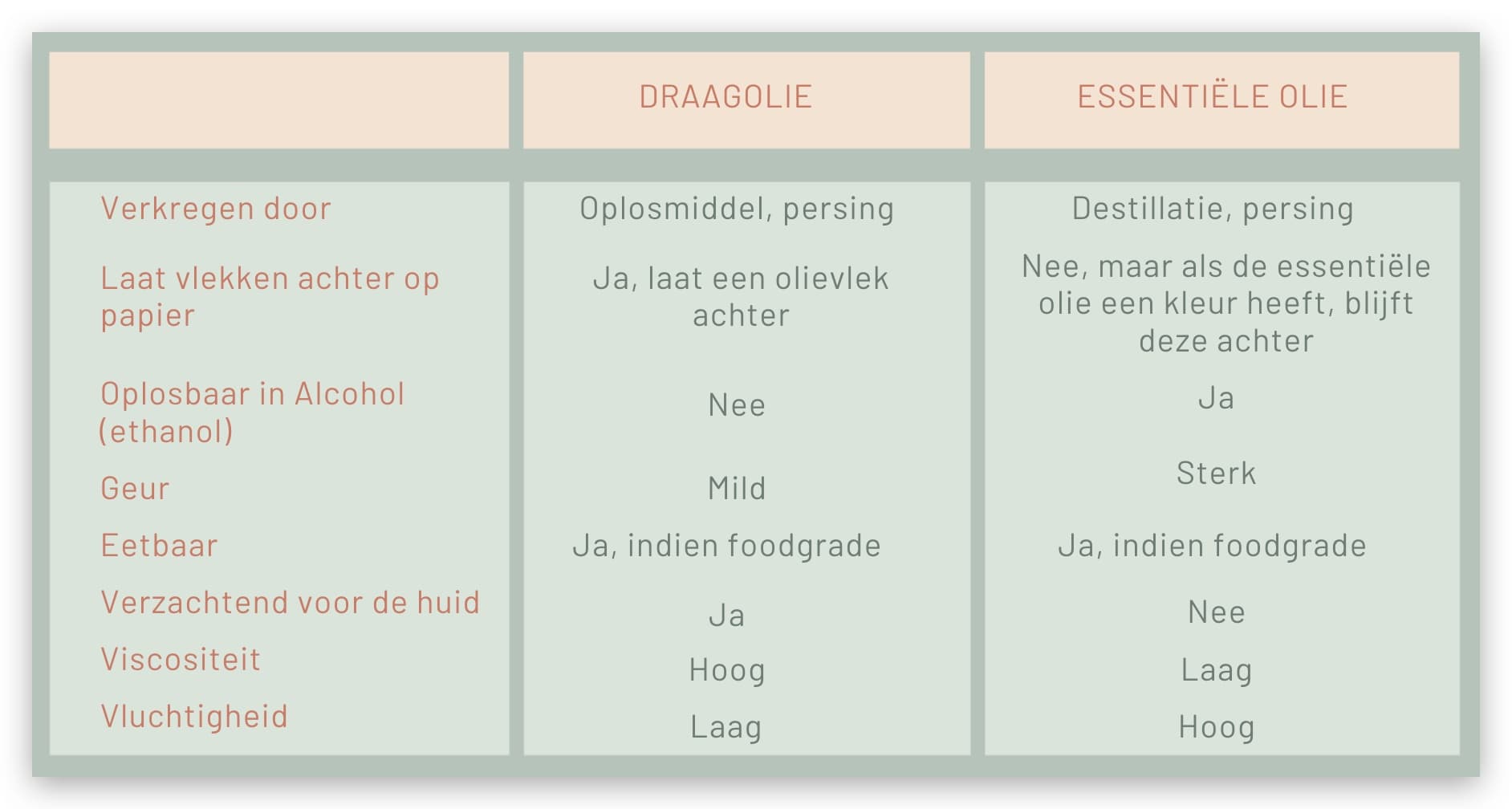
You will see that the olive oil leaves a slippery layer on your hand and does not absorb very quickly. The essential oil will evaporate and leaves no layer behind. I understand that it is sometimes difficult to tell the two apart. That is why I have made the table below for you to show the clear differences.
In the table below you will see a summary of the difference between a Carrier Oil and Essential Oil.
Viscosity could be described as thickness or stickiness. Water, for example, is a liquid with low viscosity. And honey is a liquid with high viscosity.
Volatility is a chemical term that indicates the degree to which the liquid evaporates.
Written by: Malou Hofmann