Ready-made products for your natural routine..
Do you want to stay updated on offers, (giveaway) actions and recommendations? This way you won't miss out on anything! Not too often, we promise.


Rosehip oil is also known as the natural retinol. Retinol is a derivative of vitamin A and is an ingredient that you often find in cosmetics to combat skin ageing. Many products that reduce fine lines contain retinol. In this blog you can read more about this natural retinol.
Retinoids is the collective term for various forms of Vitamin A. We all know these as the ingredients that combat skin ageing. The two best-known forms are tretinoin, also known as vitamin A acid, and retinol. Vitamin A acid can only be obtained on prescription from your GP. Retinol is an ingredient that you find in many (anti-ageing) cosmetics. Rosehip oil is also known as the natural retinol.
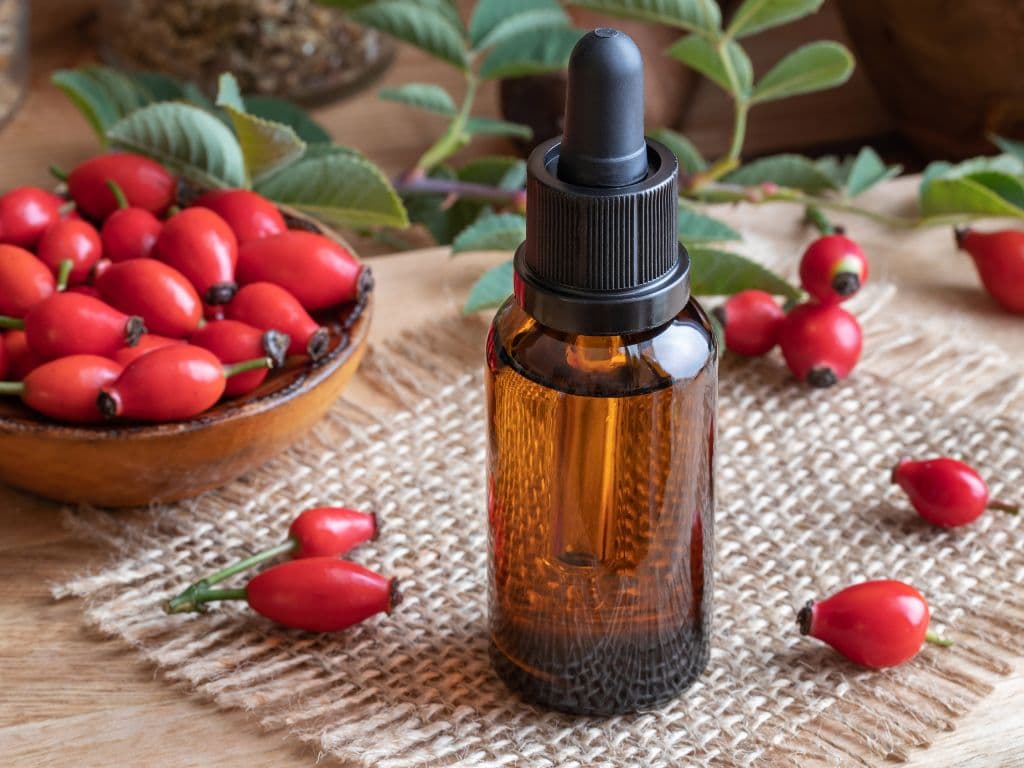
Rosehip oil, or Rozenbottelolie in Dutch, is an oil extracted from rose hips. These are the fruits of a rose bush (Rosa Canina, also known as the dog rose) and they contain dozens of small white-yellow rosehip oil seeds. The oil is obtained from these. The cold-pressed and unrefined rosehip oil is yellowish to orange-red in colour. This depends on the pressing. Please note: rosehip oil can temporarily give an orange-red glow to the skin and may transfer onto clothing or bedding.
Rosehip oil is naturally rich in vitamins (E) and minerals, essential fatty acids and beta-carotene. Essential fatty acids help our skin to recover and repair itself. Because of this, however, the oil is more prone to oxidation. It is therefore best to store rosehip oil in a cool place or to mix it with a carrier oil to extend its shelf life. Beta-carotene (provitamin A) has a strong antioxidant effect and therefore helps to protect the skin against free radicals and counteracts premature skin ageing. In addition, rosehip oil contains trans-retinoic acid.
Trans-retinoic acid is a natural precursor of vitamin A. It therefore has a comparable effect to vitamin A (tretinoin), but without the side effects such as irritation and light sensitivity. It promotes the repair and regeneration of (damaged) tissue. It should, however, be noted that trans-retinoic acid only occurs in cold-pressed rosehip oil. Not in rosehip oil from hot pressing or oil that has been extracted with a solvent. It stimulates the production of collagen and elastin. This makes the skin firmer and helps the oil to prevent and reduce fine lines. It also promotes a more even complexion.
Scars
Rosehip oil can be used for the care of scars. These can be fresh scars or somewhat older ones. Rosehip oil promotes skin repair and hydration and improves elasticity. You can also use this oil for stretch marks.
Skincare
As a skincare product, rosehip oil is a fantastic ingredient. Especially for more mature skin. Rosehip oil hydrates the skin, improves elasticity and reduces fine lines. You can use rosehip oil directly on the skin or, even better, mix it with a carrier oil.
Literature
Concha, J. et al – Effect of Rosehip extraction process on oil and defatted meal physicochemical properties
Journal of the American Oil Chemists’ Society 2006; 83 (9): 771 – 775
Pareja, B., Kehl, H. – Contribution to the identification of Rosa aff. rubiginosa L. oil Rose Active
Ann. Real Acad Farm 1990: 56; 283 – 294
Phetcharat, L., Wongsuphasawat, K., Winther, K. The effectiveness of a standardized rose hip powder, containing seeds and shells of Rosa canina, on cell longevity, skin wrinkles, moisture, and elasticity. Clin Interv Aging. 2015; 10: 1849–1856.
Book: Modern Cosmetics: ingredients of natural origin.
Written by: Helena Laarman