Ready-made products for your natural routine..

Free shipping from €35
★★★★★ 9.3 / 10 out of 9,500+ reviews
Ordered before 23:00, shipped today
Natural HeroesNatural Heroes
Natural Heroes
Shop
Recipes
Information
Community
About us

Our community is the place where Heroes come together to share knowledge, experiences and ideas about nature.

Join us!
Join our community
User
My account
Cart
Basket
Wishlist
Favorites
★★★★★Kiyoh 9.3 / 10 — 9,500+ reviews
Shop
Recipes
Information
Community
About us

Our community is the place where Heroes come together to share knowledge, experiences and ideas about nature.

Join us!
Join our community
WishlistCart
User
Shop
Recipes
Information
Community
About us
Aromatherapy
Cosmetics
Do It Yourself
Herbs & Extracts
Auxiliaries
Oils & Butters
Tools & More
Ready to use
All
Bundles
Gift Card
New
Sale
FARM TO TABLE
Lavender Luisieri
Cistus
Helichrysum Stoechas
Rosemary
Eucalyptus
Spanish Thyme
ESSENTIAL OIL BLENDS
Bombshell
Eternal Bloom
Fresh Balance
Less Stress
Morning Breeze
Morning Sunshine
Night Night
Rosemary Bliss
Sweet Dreams
Tropical Zest
Velvet Rose
ESSENTIAL OILS (A-G)
Amyris
Anijs
Basilicum
Bergamot
Bergamot (Furocoumarin-Free)
Berk
Berkenteer
Bittere Amandel
Blauwe Kamille
Blue Tansy
Cajeput
Cederhout
Citroen (FCF-vrij, Gedestilleerd)
Citroen (Koudgeperst)
Citroen Eucalyptus
Citroengras
Citronella
Cognac
Copaiba
Cypres
Duizendblad
Eucalyptus (Globulus)
Eucalyptus (Radiata)
Frankincense (Carterii)
Frankincense (Serrata)
Gember
Geranium
Grove Den
ESSENTIAL OILS (H-N)
Helichrysum
Hinoki
Hô hout
Jeneverbes
Kamfer
Kamille (Rooms)
Kaneelschors
Kardemom
Korianderzaad
Kruidnagel
Kurkuma
Laurierblad
Lavandin
Lavendel
Lavendel (Spijk)
Limoen
Mandarijn
Manuka
May Chang
Mirre
Munt
Neroli
Nootmuskaat
ESSENTIAL OILS (O-Z)
Oranjebloesem / Neroli (Tunesie)
Oregano
Palmarosa
Palo Santo (Heilig hout)
Patchouli
Pepermunt (Mentha Arvensis)
Pepermunt (Mentha Piperita)
Peru Balsem Oleoresin
Petitgrain
Petitgrain (Bigarade)
Pink Grapefruit
Ravintsara (Biologisch)
Roze Peper
Rozemarijn
Rozemarijn (Cineol)
Rozemarijn Verbenon - Biologisch
Rozengeranium
Rozenhout
Salie (Scharlei)
Sandelhout
Siberische Zilverspar
Tea Tree
Tea Tree Citroen
Tijm
Verbena
Vetiver
Wintergroen
Witte Champaca (Magnolia)
Wortelzaad
Ylang Ylang (Eerste Graad)
Yuzu
Zoete Sinaasappel
Zwarte Peper
BlogsAll items
How does DIY work?Do's & Don'ts
27 Ingredients to Avoid in CosmeticsAlcohol, Aluminium, and 25 more...
(Un)refined, Organic or Cold-pressed?We explain the terms.
Natural vs Mineral OilsWhy you’d prefer not to use mineral oil.
Carrier oil vs essential oilThey share the word "oil," but are very different.
Basic Skincare RoutineA 100% natural skincare routine for your skin type.
Preservatives in SkincareWhich is suitable in your DIY?
What is the community?The place where Heroes come together!
Earth CoinsEarn points and get discounts.
Community loginIf you are already a member of our community.
About usOur mission & the story
WholesaleFor businesses.
VacanciesMake a difference!
Affiliates
ContactA response within 1 working day.
Free shipping from €35
★★★★★ 9.2 / 10
Ordered before 23:00, shipped today

Sign up for our newsletter

Do you want to stay updated on offers, (giveaway) actions and recommendations? This way you won't miss out on anything! Not too often, we promise.

You can unsubscribe at any time.
Botanical drawing of a plant
Natural Heroes

"We believe that living healthy and sustainably should be easy."

Reviews9.3 / 10 out of 9,500+ reviews

Customer service
  • Get in touch
  • Ordering & Delivery
  • Returns
  • Right of withdrawal
  • Frequently Asked Questions
  • My account
Raw materials
  • Carrier oils
  • Fragrance oils
  • Hydrosols
  • Clays & Powders
  • Herbs & Plant Powders
  • Butters & Waxes
  • Excipients
Products
  • All products
  • Do It Yourself
  • Recipes
  • Tools & More
  • Packaging
About Us
  • Community
  • Greenspark
  • Blog
  • Wholesale
  • Vacancies
  • Contact
  • Terms and Conditions
  • Privacy Policy
  • Right of withdrawal
Updates?
  • instagramInstagram
  • facebookFacebook

ideal
visa
mastercard
bitcoin
sofort
applepay
Terms and ConditionsRight of withdrawalDisclaimer© Natural Heroes 2026
  1. Blog
  2. Witch Hazel: the magic wand for your skin problems

Witch Hazel: the magic wand for your skin problems

  • What is Witch Hazel?

  • Where does Witch Hazel come from?

  • What makes Witch Hazel special?

  • How is Witch Hazel made?

  • Why is there alcohol in Witch Hazel?

  • What can you use Witch Hazel for?

  • What does Witch Hazel look like?

  • How can you best store Witch Hazel?

  • Where can you buy Witch Hazel?

What is Witch Hazel?

Witch Hazel is also known in the Netherlands as Toverhazelaar and is a medicinal compound that is widely used for skin ailments. It is made from the branches, leaves and bark of the Hamamelis Virginiana, or witch hazel shrub. This shrub grows abundantly in North America as well as in Asia.

Botanist Carl Linnaeus observed that the witch hazel shrub often produced flowers, fruit and leaves at the same time. For that reason he gave the witch hazel shrub the Latin name Hamamelis. Hama means 'at the same time' and melis stands for 'apple'. By apple he is of course referring to the fruit.

Contrary to what many people think, the English name Witch Hazel is not derived from the English word for witch. Witch actually comes from the Old English word wiche which means flexible or pliable. This name speaks for itself when you see how the branches of the witch hazel shrub can twist.

Witch Hazel is primarily known for relieving inflammation and calming sensitive skin. For this reason the shrub has been pressed, boiled and steamed by people for centuries.

Where does it come from?

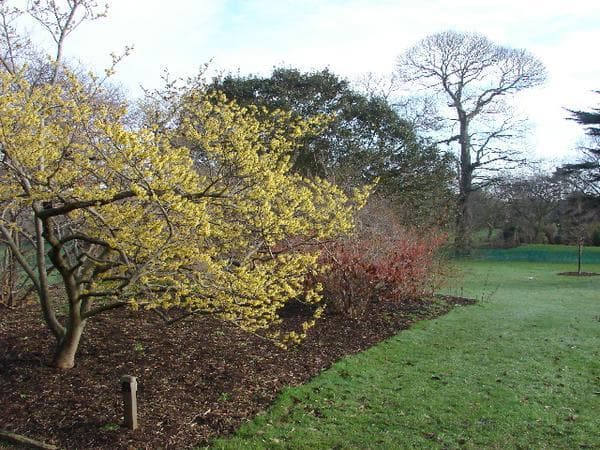
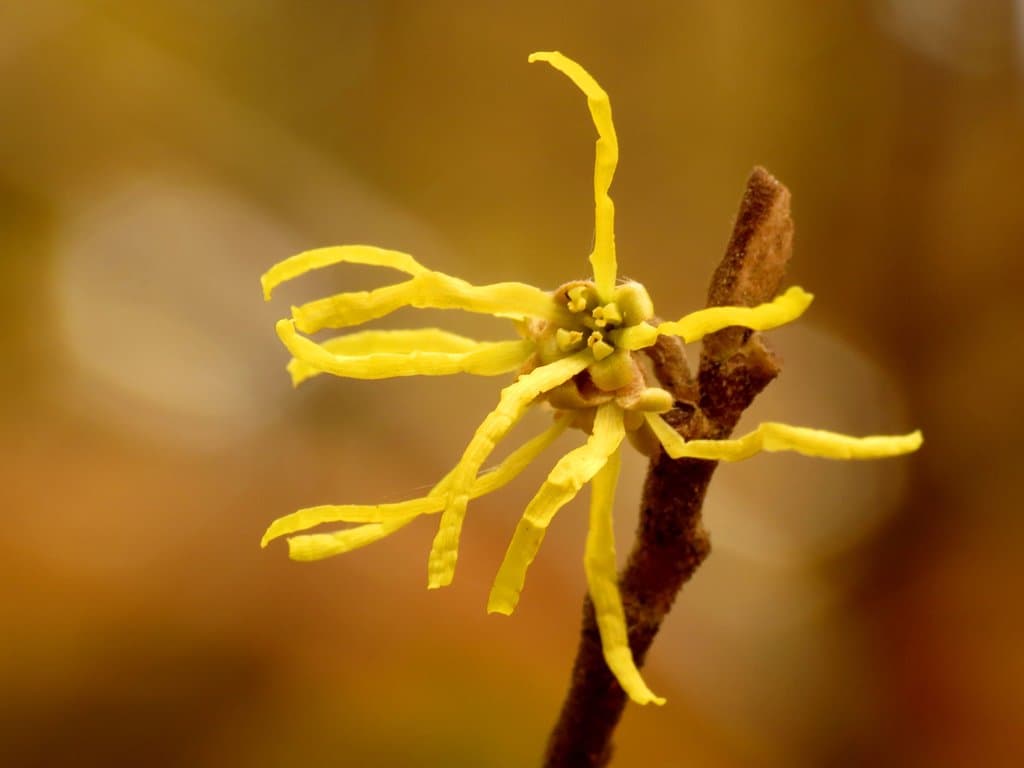
Although the witch hazel shrub grows in both North America and Asia, most Witch Hazel is made from the variety found in North America. The shrub in North America is in fact slightly different from the witch hazel shrub in Asia. The North American shrub is between 3 and 8 metres tall and has a unique appearance thanks to its many golden-yellow flowers. These flowers have four slender, reed-shaped petals up to 2 centimetres long.

The Native American tribes were very impressed by this beautiful shrub. When they saw that the flowers of the witch hazel shrub grew in winter instead of in spring, they immediately knew that the witch hazel shrub had special properties.

Native Americans therefore made full use of this unique plant. For example, they used the flowers and leaves to make tea for colds and coughs. The bark was used for sores and bruises. After all, the shrub contains anti-inflammatory properties that constrict blood vessels. This can reduce swelling considerably.

What makes Witch Hazel special?

The fact that the flowers grow in winter is already special in itself. But the witch hazel shrub contains a number of special substances that offer a healing effect for the human body. For example, Witch Hazel contains flavonoids that stimulate blood circulation in the skin. These are antioxidants that are also commonly found in various types of fruit, vegetables, herbs, nuts, seeds and plants. Flavonoids protect skin tissues against free radicals. In addition, Witch Hazel has unique anti-inflammatory properties that help to care for impure, irritated and damaged skin.

The special combination of flavonoids and the anti-inflammatory properties therefore makes Witch Hazel well suited to various skin complaints. For example, you can use Witch Hazel to treat wrinkles, bags and age spots. It also works excellently for caring for pimples and blackheads. Thanks to its unique astringent action, Witch Hazel is able to give the skin more elasticity, which makes the skin look considerably younger

How is Witch Hazel made?

Witch Hazel is a hydrosol and is made from the witch hazel shrub. Hydrosols are flower or herb waters that arise as a kind of byproduct of the specific production process of essential oils. They contain water-soluble plant components that often give these hydrosols the scent of the essential oil, but are not as strong. In this hydrosol, the dried branches, bark and leaves are drawn out of the shrub with steam. When the steam has eventually cooled into water, two products remain.

The first is a fat-soluble (lipophilic) part. In the cosmetics world this part is called essential oil.

The second part is distillation water with water-soluble parts. This part is called a hydrosol. In most Witch Hazel a little alcohol or another preservative is also added.

Why is there alcohol in Witch Hazel?

Hydrosols generally do not have a long shelf life, and the same goes for Witch Hazel. Without alcohol, Witch Hazel would last at most about a month. For this reason alcohol is often added to Witch Hazel, as a 'preservative' therefore. So there is alcohol-based Witch Hazel, but an alcohol-free alternative is Witch Hazel with phenoxyethanol.

Phenoxyethanol is a colourless liquid and has a strong antimicrobial action on bacteria, yeasts and fungi. Because of this action, phenoxyethanol gives hydrosols such as Witch Hazel a longer shelf life. You also find this substance in many things from nature, such as grapefruit, for example.

With a small percentage of alcohol or phenoxyethanol, Witch Hazel is shelf-stable for about a year. That is therefore more than ten times as long as if you did not add these substances. So before purchasing Witch Hazel, take a good look at the list of ingredients. It would be a shame if the product is contaminated by bacterial growth

What can you use Witch Hazel for?

As mentioned earlier, Witch Hazel can be used for various purposes. Because of its anti-inflammatory and astringent action, Witch Hazel is particularly suitable for all kinds of skin complaints. Below we list the most common ways in which you can use Witch Hazel.

What does Witch Hazel look like?

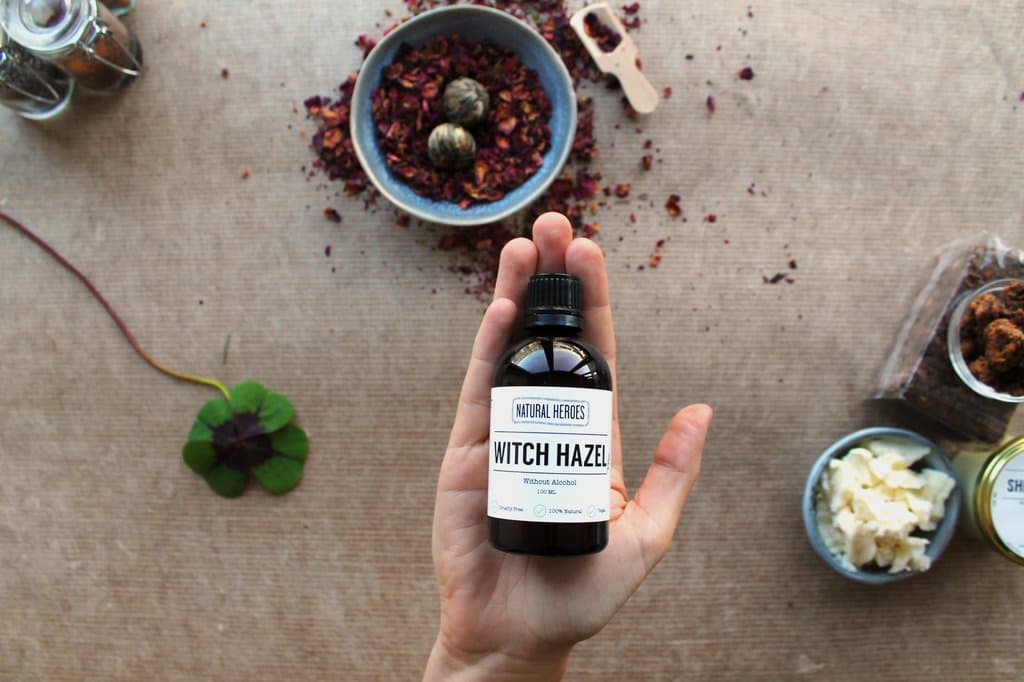
Witch Hazel is a hydrosol and therefore actually looks like water: transparent and liquid. Some people are of the opinion that Witch Hazel smells musty. This is because Witch Hazel is made from the witch hazel shrub, which does not naturally have a floral scent. Moreover, in addition to the leaves and flowers, many branches are also used to make Witch Hazel. Branches generally smell less pleasant. So it may be that at first you have to get used to the scent a little, but this scent fades away again within one minute. Moreover, you get used to the scent quickly.

How can you best store Witch Hazel?

With additives such as alcohol or Phenoxyethanol, Witch Hazel is shelf-stable for about a year. Without these additives, at most a month. The older Witch Hazel is, the less effective the healing properties will be, but the hydrosol remains good enough to care for your skin.

It is best to store Witch Hazel in its original packaging in a dark cupboard. If you use Witch Hazel as a toner, it is advisable to store it in a cool place such as the fridge. After all, Witch Hazel has the best effect when cold.

Where can you buy witch hazel?

Witch Hazel (Alcohol-free)

Witch Hazel (Alcohol-free)

€6.29

Witch Hazel - Organic (Alcohol-free)

Witch Hazel - Organic (Alcohol-free)

€8.99

Witch Hazel (Alcohol Based)

Witch Hazel (Alcohol Based)

€6.39