Ready-made products for your natural routine..
Do you want to stay updated on offers, (giveaway) actions and recommendations? This way you won't miss out on anything! Not too often, we promise.


Eczema is a common skin condition. Natural skincare can help with eczema, a dry, flaky skin, redness or itching. Atopic eczema (constitutional eczema) and contact eczema are the most well-known types of eczema. Read all about eczema and natural skincare in this blog.
Eczema is a common skin condition. It is not contagious, but it can cause a lot of discomfort. There are many natural products that help with eczema, dry, flaky skin, redness or itching. Eczema is an inflammatory reaction in the upper layers of the skin. The most well-known forms of eczema are: atopic eczema (constitutional eczema) and contact eczema. In this blog, you will read about the different types of eczema and what you can do to reduce it.
Eczema is a skin condition in which there is an inflammatory reaction in the upper layers of the skin. The skin's barrier function is disrupted and as a result the skin retains moisture less well. The consequence is vulnerable skin that is less well protected against harmful substances from outside. The harmful substances trigger an inflammatory reaction and this causes red skin, sometimes also small blisters, red bumps, scabs, flakes and itching. Eczema often develops in certain areas, which sometimes flare up and are sometimes a little calmer.
Atopic eczema (constitutional eczema)
Contact eczema
Clown eczema
Seborrheic eczema.

Atopic eczema or constitutional eczema is an inflammatory skin disease in which the skin barrier is disrupted. Some people with atopic eczema also lack the protein filaggrin, which is important for the structure of the skin. This causes dry skin and makes the skin more permeable to harmful substances.
Allergic contact eczema. This form of eczema occurs when the skin comes into contact with certain substances that cause an allergic reaction. An example of this is a nickel allergy.
Clown eczema. This looks like redness around the mouth. The cause of clown eczema is not yet known. It may be caused by excessive skincare and stress.
Seborrheic eczema: in this form of eczema, red or yellow-red spots appear on the skin. These are covered with greasy scaling. This form of eczema seems to be caused by the yeast Pityrosporum. This yeast normally occurs on the skin, but in some people it causes an inflammatory reaction on the skin. Dandruff on the scalp can be seen as seborrheic eczema on the scalp.
Eczema has many similarities with Psoriasis. Psoriasis is an autoimmune disease. Here, the skin reaction is not caused by environmental factors, but by the body's own immune system.

Face - Atopic or Clown eczema
Scalp / face - Seborrheic eczema (in babies this is called cradle cap)
Hands & feet - dry eczema
Body folds - armpits, elbow, groin, back of the knee
Exactly what the cause is, is not yet known. Atopic eczema comes from the word 'Atopy’, which means a tendency to react allergically. Causes such as hereditary predisposition and environmental factors are often mentioned. With environmental factors you can think of: diet (food intolerance), stress, toxic ingredients in cosmetics such as SLS, PEGs, parabens, and alcohol.

Eczema is often treated with anti-inflammatory creams, such as corticosteroids. But did you know there are also other (natural) options?
What can you do to prevent and reduce eczema?
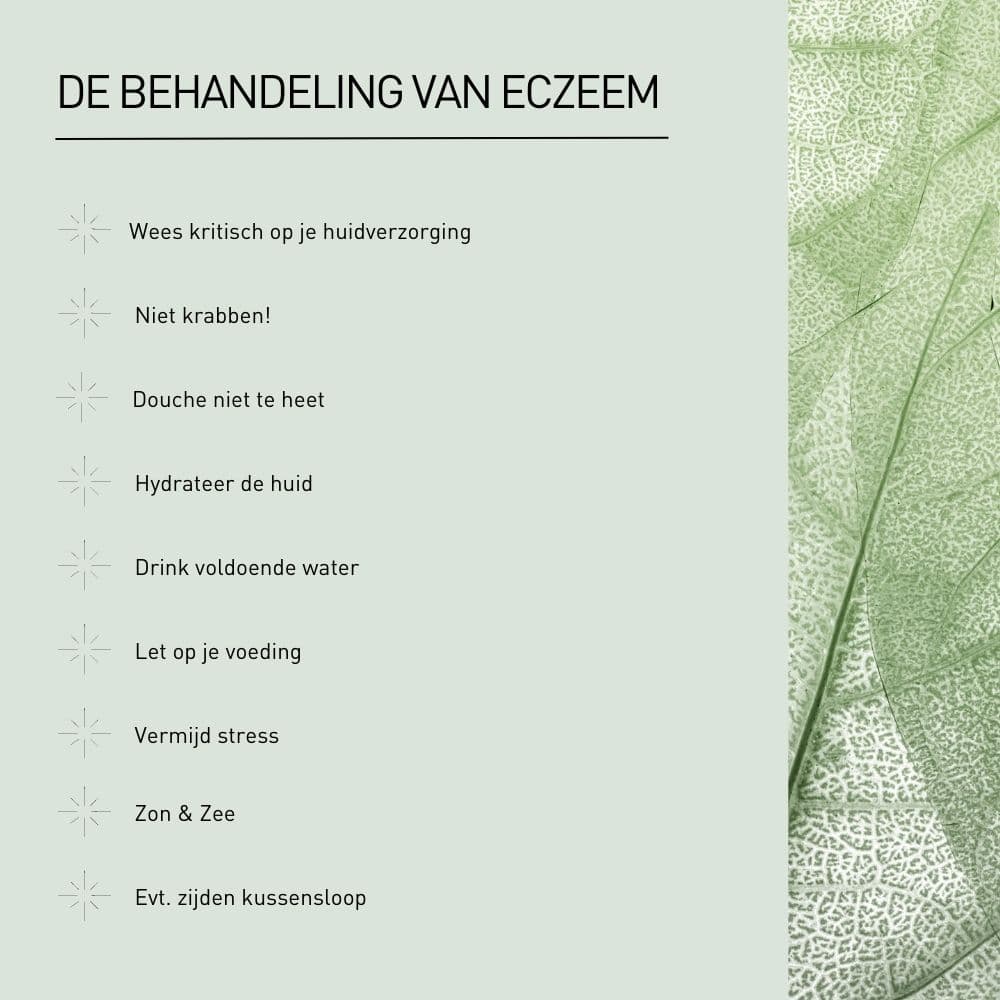
Be critical of your skincare!
Many cosmetic products attack the natural oils on the skin. You cannot afford to lose these when your skin is already struggling to retain moisture. In any case, avoid these toxic chemicals.
27 ingredients you want to avoid in cosmetics.
In this blog, we help you decipher ingredient lists and show you which 27 ingredients you really don’t want in your skincare!

Do not scratch.
However difficult this may be. Cool the skin and make sure the skin does not dry out.
Do not shower too hot.
And use mild shower products without irritating ingredients.
Hydrate the skin well.
With plant oils or hydrating ingredients.
Drink enough water.
Pay attention to your diet.
Seek advice from an (orthomolecular) nutritionist who specialises in eczema.
Avoid stress.
Address the cause and improve your resistance.
Sun and sea.
Sun and sea (salt water) have a positive influence on eczema, but do be sensible with sunlight.
Optionally: sleep on a silk pillowcase.
Pillowcases made from silk treated with silver ions are said to reduce bacterial growth. Change your pillowcases regularly.

There are various natural products that have been shown to work for complaints such as dry, red, irritated and itchy skin. These include:
Shea butter
This butter contains skin-identical fats to optimally restore and nourish the skin. These fats protect the skin against external influences and dehydration. It also hydrates the skin and is rich in essential fatty acids and vitamins. Shea butter forms a protective layer over the skin so that moisture is retained and the skin is nourished and restored. This also reduces itching.
Colloidal oatmeal powder
Colloidal oatmeal powder is an age-old treatment for various skin conditions. It relieves skin irritation, rashes and itching. The carbohydrates and proteins from oatmeal powder can bind to the skin, providing a protective layer. This counteracts moisture loss. The fibres in oatmeal powder help to attract and retain moisture.
How do you use it? Make a mask from oatmeal powder or take a lukewarm oatmeal bath. After the bath, gently pat your skin dry and apply a hydrating oil, cream or butter.
Coconut oil
Coconut oil is effective in reducing dry, red, itchy skin and improves the barrier function (and thus the loss of moisture from the skin). In this study coconut oil was compared with mineral oil in patients with eczema. Treatment with coconut oil showed a better effect than mineral oils.
Borage oil
Borage oil contains essential fatty acids and linoleic acid and normalises the barrier function of the skin.
Jojoba oil
Jojoba oil: due to its high content of wax esters, jojoba oil provides good restoration of the skin barrier.
Sesame seed oil and Safflower oil
Sesame seed oil and Safflower oil are nourishing and hydrating oils that have a positive effect on dry skin.
Essential oils
For example, you can think of Lavender, Cedarwood, and Geranium. Note: use a maximum of 1% essential oil and test on a small patch of skin beforehand.
How do you search on the website?
Did you know that you can very easily search by skin condition on the website? Go to all products and select your skin condition.

Next, all products that are suitable for this skin condition will appear. Choose the products that appeal to you and experiment with different products or ask your question in the community.
Sources:
https://pubmed.ncbi.nlm.nih.gov/19562883/
https://www.ncbi.nlm.nih.gov/pmc/articles/PMC5796020/
https://pubmed.ncbi.nlm.nih.gov/17373175/
https://onlinelibrary.wiley.com/doi/full/10.1111/ijd.12339\\
https://europepmc.org/article/med/8095744 https://www.huidarts.com/huidaandoeningen/eczeem/
https://www.ncbi.nlm.nih.gov/pmc/articles/PMC5796020/#B113-ijms-19-00070 https://www.huidziekten.nl/zakboek/dermatosen/etxt/EczemaSeborroicum.htm
https://www.ncbi.nlm.nih.gov/pmc/articles/PMC8878527/#B78-pharmaceuticals-15-00210
https://www.onlinedermatologie.nl/eczeem-2/
Written by: Helena