New: No BS Deo stick, up to 40% off Shop now
Do you want to stay updated on offers, (giveaway) actions and recommendations? This way you won't miss out on anything! Not too often, we promise.


"I don't want preservatives in my skincare." That's something we hear a lot at our customer service. But if you make products with water (such as creams and gels), you have to use a preservative. Without a preservative, mould, bacteria or yeasts will grow in your product in no time. That's bad for your skin and can even be dangerous.
As soon as there's water in a product, you give bacteria and mould a chance to grow. That's not only bad for your product, it can also harm your skin. Even if it still looks or smells fine, it may already contain micro-organisms you don't want to put on your skin.
A preservative prevents or slows down the growth of micro-organisms (such as bacteria, moulds and yeasts) in your DIY formula. Without a preservative, a product can become contaminated within just a few days or weeks, especially if it contains water. Most preservatives disrupt how bacterial or fungal cells work. They can do this, for example, by damaging the cell wall, disrupting enzymes, drying out the microbes or acidifying the environment. Not all preservatives work equally well against everything. Some mainly tackle bacteria (such as Leucidal) and others are also good at inhibiting moulds and yeasts (such as Greenservative).
Many people immediately associate preservatives with something chemical or unhealthy, but in reality a preservative in cosmetics is essential for the safety of your product and your skin. Without a preservative, your products can start to smell, go mouldy or even develop dangerous bacteria. And there are now several natural options available.
There are a number of safe preservatives that are natural or approved by COSMOS for use in natural cosmetics. Here's an overview:
When choosing a preservative, you need to take a few crucial factors into account. It's not just a case of "adding something": it determines the safety, shelf life and reliability of your product. Here's what you really need to look out for:
1. Does your product contain water?
As soon as there's water or a water-based substance in your formula (such as a hydrosol or Aloe Vera Juice), you need a preservative. Only oil? Then an antioxidant such as vitamin E is usually enough.
2. pH range of your formula
Not every preservative works in every pH range. Some only work between pH 4 and 5, others between 3 and 8. If your preservative is outside its range, it's ineffective. Test and know the pH of your final product. We often hear from customers that they added preservatives but it didn't work in the end. That's because the pH wasn't tested. This is really important! Curious how to test the pH? Then watch this video.
3. Type of product
Is it a leave-on serum, a thick cream, a shampoo or a face mist? Not every preservative works well in every type of formula. Some are suitable for water-based sprays, others are better suited to emulsions or gels.
4. Who is going to use it?
Are you making products for babies or children? Then you should avoid preservatives containing salicylic acid, among others. Choose mild, skin-friendly options that are suitable for sensitive skin.
5. Shelf life and use
The higher the risk of contamination, the stronger the preservative needs to be. Note: it's important to work in a sterile environment, use a sterile jar and, of course, only touch the jar with clean hands. Always add the right percentage of preservative. Too little preservative won't protect your product enough. Using a recipe from our website? We've carefully chosen a specific preservative for it, so you can't simply swap one preservative one-for-one for another. If a preservative can be replaced, you'll find this in the ingredients table by clicking 'replace with alternative'. Not sure? Send an email to support@naturalheroes.nl.
6. Personal preferences and scent
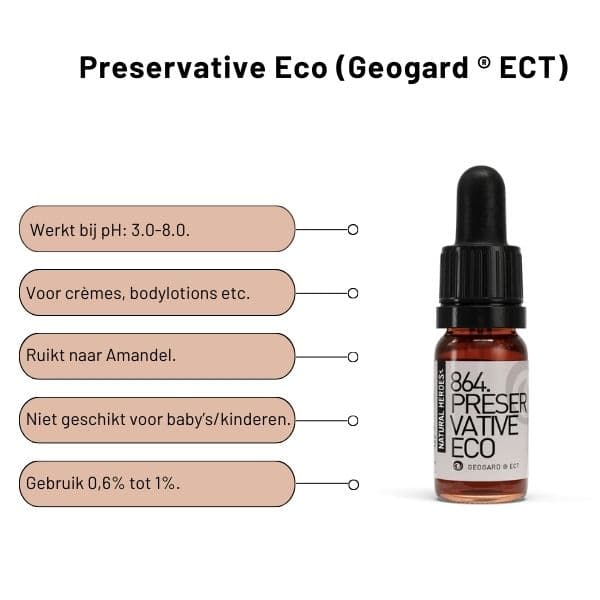
Some preservatives (such as Preservative Eco) have a light scent. Keep this in mind when formulating.

There are a few signs that show your product is no longer good.
Change in smell: A sudden sour, rotten, musty or fermented smell
Change in appearance: such as discolouration or actual spots of mould
Change in consistency: your product becomes grainy, stringy or gel-like when it wasn't before, or it separates.
Skin irritation: itching, redness, flaking or any other skin irritation
Notice any of this? Then your product probably wasn't preserved properly and it's best to throw it away!

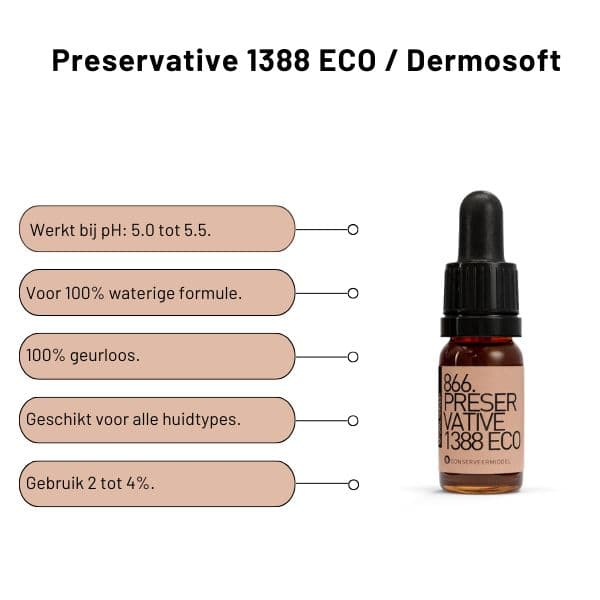
Preservative 1388 Eco consists of Glycerine, Water, Sodium Levulinate and Sodium Anisate. This preservative works well against moulds and bacteria, but has limited effect against moulds. If you're looking for full protection, it's best to combine it with an additional preservative such as Preservative Eco. This preservative is very suitable for preserving toners or sprays (100% water-based products), but doesn't work in creams.

Preservative Eco consists of Benzyl alcohol, Salicylic acid, Glycerine and Sorbic acid. This preservative offers broad-spectrum protection against bacteria, yeasts and moulds, so you don't need to combine it with other preservatives. That makes it a great ingredient in many formulas. Please note: because it contains salicylic acid, this preservative isn't suitable for products intended for babies and children. Preservative Eco has a light scent (almond-like, from the benzyl alcohol), but this usually disappears in the final formula, especially when you use Essential oils.

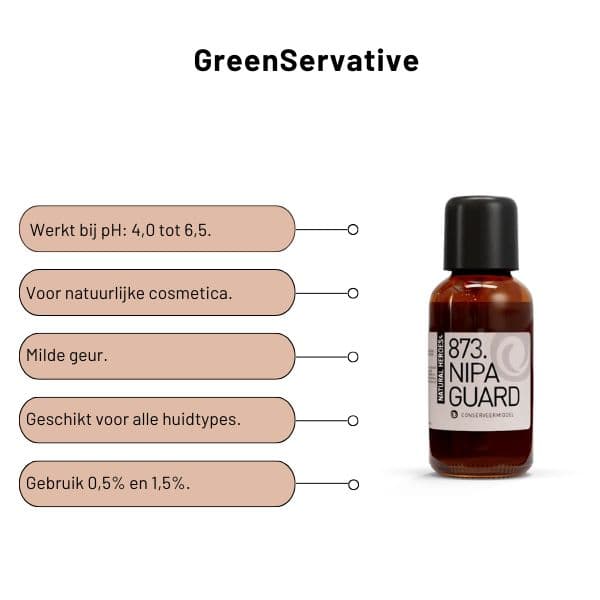
GreenServative consists of Benzoic acid, Sorbic acid and Propanediol. It's a natural preservative that works effectively against bacteria, yeasts and moulds, so you don't need to combine it with other preservatives. It's suitable for both leave-on and rinse-off products, such as creams, serums, gels, shampoo and conditioner. It's also suitable for every skin type.

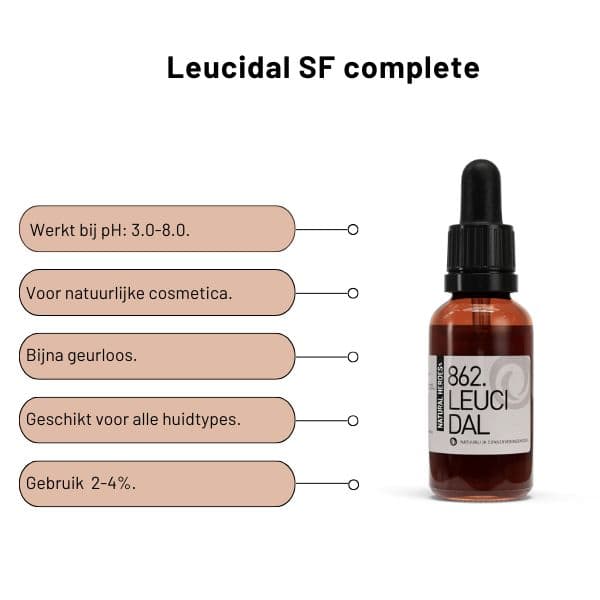
Leucidal SF Complete is a preservative based on Lactic acid ferment, Lactobacilli and Coconut Extract. Are you working with a complex product (such as creams in jars, or warm and humid storage conditions)? Then Leucidal isn't strong enough as the only preservative. Leucidal is very suitable for the most sensitive skin.

In a product without water, so only with oils or butters (such as a face oil or a balm without water), bacteria and moulds don't grow. But: oils can oxidise. That means they go rancid and lose their effectiveness.
That's why you don't add a preservative to oil-based products, but you do add an antioxidant. Vitamin E or Rosemary Antioxidant slows down the oxidation process and helps keep your oils good for longer. Add 0.5-1% Vitamin E or 0.2% Rosemary Antioxidant to your formula.
Products that come into contact with water, for example when you use or store them in the shower, also need to contain a preservative! Even if they aren't made with water-based ingredients. Think of hair masks, conditioners or scrubs. As soon as water gets in, the risk of mould and bacterial growth is high.