Ready-made products for your natural routine..
Do you want to stay updated on offers, (giveaway) actions and recommendations? This way you won't miss out on anything! Not too often, we promise.


Squalane has many special properties for the skin. It is colourless, odourless and absorbs quickly into the skin. It hydrates and softens the skin and feels non-greasy. Read all about Squalane here.
What is Squalane?
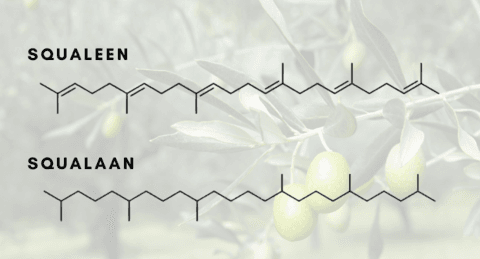
What is the difference between Squalane and Squalene?
What is Squalene?
Where does Squalene come from?
How is Squalene made?
What makes Squalane so special?
What can you use Squalane for?
Are there differences in the quality of Squalane?
How should you best store Squalane?
How long does Squalane last?
For which skin is Squalane suitable?
What does squalane do for the skin?
Where can you buy Squalane?
Squalane is a colourless and odourless plant-based liquid with an oily consistency that is widely used in skincare products.
This is actually very simple. Without squalene, squalane would not exist. In other words: squalane is the saturated component of squalene. Squalene is transformed into squalane through hydrogenation. Because squalene is very sensitive to oxidation and is thus an unstable ingredient to process in cosmetics, the chemist Sebastian Sabetay devised a way to stabilise it by hydrogenating the squalene. Since squalane cannot exist without squalene, we will go into more detail about squalene below.

Squalene is an organic molecule that can be found in humans, plants, bacteria, fungi, coral and amphibians. Squalene is produced in the human liver and circulates in our bloodstream. The substance is one of the most important lipids of our skin cells and is synthesised in our sebaceous glands. Our total sebum content consists of 13% squalene. Squalene can be found in food, cosmetics, health supplements and even in the pharmaceutical industry, to make a vaccine more immunogenic.
Squalene was discovered in 1906 by the Japanese researcher Dr. Mitsumaru Tsujimoto during research into obtaining oil from the liver of the shark. He discovered that the unsaponifiable parts of the oil contained highly unsaturated hydrocarbons.
Ten years later, Tsujimoto succeeded in isolating the unsaponifiable parts by means of a vacuum distillation column. He named the chemical formula C30H50 Squalene, derived from the Latin word Squalidae, which refers to the shark family.

Since shark liver oil, with a percentage of 96%, is still the richest source of squalene, it has been a very popular choice among cosmetic companies for decades. Aside from the fact that this poses an enormous threat to marine life and the ecosystem as a whole, there are also health risks associated with obtaining squalene from sharks. Among other things, the pollution of seawater. The share of POPs, or persistent organic pollutants, in the squalene is enormous when it is obtained from sharks. Because these eternal pollutants, consisting of pesticides and heavy metals among others, cannot be broken down biologically, they end up in the liver of the shark and then in the squalene. Not a good idea, then!
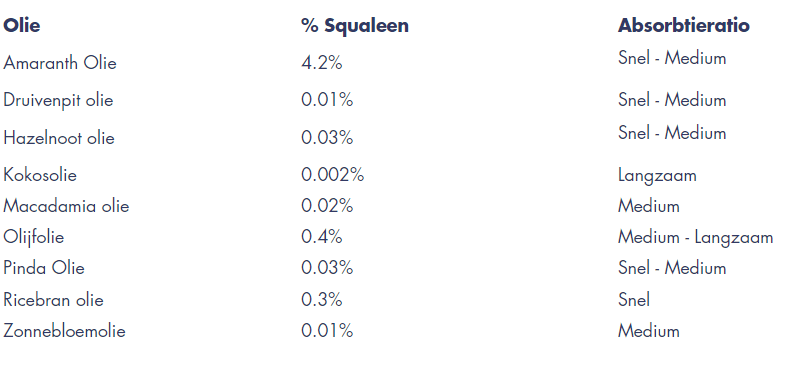
Fortunately, modern technologies have made it possible to obtain squalene from plant sources too (phytosqualane), such as from olives, amaranth and even sugarcane. Below you can see in which oils squalene can be found and how quickly these oils are absorbed. If you take an oil with a slow absorption rate, such as coconut oil for example, this means that it remains on the skin for a long time and stays greasy.

There are various sources from which squalene is extracted. The squalene from Natural Heroes is extracted from olives. Around 750 million olive trees are cultivated worldwide. Most of these oils (about 75%) come from Italy, Spain and Greece. A small quantity of these olives is used for the cold pressing of (extra) virgin olive oil, and the rest of the crude oil is refined for consumption. During the final step of the refining process, in which the scent of the oil is removed, the oil is heated in a vacuum with steam to a high temperature (220°C). This removes all unwanted volatile organic compounds. All glycerides, fatty acids and unsaponified components are stripped during this process and condensed into acid oils. This acid oil contains 10% to 20% squalene, depending on the refining process. The squalene from this oil is then hydrogenated back into squalane. In this way, the enormous consumption of olive oil and the need for refining have ensured that squalane can be obtained in large quantities.

Squalane is an important ingredient in skincare and very special in its properties. It scores very high on sensory properties. It is colourless, virtually odourless, absorbs quickly into the skin, has excellent moisturising and softening effects, and does not feel greasy. Squalane also cannot go rancid, oxidise or dry out and, unlike other saturated oils, it is liquid.
Squalane is an emollient. The term 'emollient' is used for raw materials that have the ability to soften the skin. It derives from the Latin verb 'mollire', which means 'to soften'. Emollients are often found in moisturisers and serve as a kind of extra skin barrier that prevents the skin from losing moisture. The water-attracting substances in a moisturiser also ensure that extra water is put into the skin. A fantastic addition to a cream, then.
Squalane, like squalene, is soluble in oil and can be added to oil blends and creams in the oil phase. It is a very stable oil that does not oxidise quickly and is resistant to high temperatures. It combines excellently with other carrier oils and can be used in a concentration of 0.5% up to even 100% pure.
Pure as a facial or body oil
Blended into a carrier oil
Blended into a homemade cream in the oil phase
An example of a nice squalane recipe is, for instance:
79% Carrier oil of your choice
20% Squalane
1% Vitamin E Oil
Here you can choose an oil that suits your skin and perhaps also one that itself contains squalene, to turn it into a true Squalane booster.

Squalane is of high quality when it is pure and consists 100% of the substance squalane. There are many different products on the market that contain squalane but do not consist 100% of this substance.
Squalane is best stored at room temperature (between 19 and 22 degrees Celsius) in a dark place.
Squalane is an oil that does not oxidise quickly and has a shelf life of about twelve months.
The main function of our skin is to protect us from cold, heat, UV radiation and harmful substances from outside. The sebum produced in the sebaceous glands in our skin has a water-repellent effect and protects the skin from bacteria. When there is a shortage of sebum, the skin will quickly dry out and in some cases even crack. This often happens at an older age when the secretion of sebum decreases and, combined with the loss of muscle tissue, this leads to wrinkled and crepey skin. Some people naturally have a congenital sebum deficiency. These people therefore also benefit from applying oils that mimic this sebum production. With sensitive skin too, the health of the skin barrier is particularly important and squalane can help.
Regular use of Squalane can contribute in various ways to improving the moisture balance and suppleness of the skin.
Squalane provides the skin with a thin layer that protects the skin from free radicals. Free radicals are caused by stress, air pollution or alcohol consumption. Free radicals are oxygen-containing molecules with an odd number of electrons.
The skin barrier can be called healthy when the skin feels soft and supple. Dull and dry skin can indicate that the skin barrier is damaged. When the skin barrier is damaged, it is no longer possible for the skin to retain substances such as ceramides, cholesterol and fatty acids. Squalane can fill the spaces in the loose stratum corneum and ensure that the skin feels supple again.
Squalane acts as a physical barrier between the skin and the air, which ensures that the moisture in the skin is retained and does not move to the epidermis, where it evaporates. Moisture loss in the skin can cause the skin to look dry and flaky.
On average, the skin consists of two million sebaceous glands. The facial skin contains about 400 to 500 sebaceous glands per square centimetre. Sebaceous glands are located in the dermis, beneath the epidermis. Sebaceous glands are responsible for the production and secretion of sebum, which in turn ensures that the skin is protected against external factors and dehydration. Sebum also keeps the skin supple. When the skin is exposed to a dry environment, aggressive products, changes or a hormonal imbalance, this can cause the skin to produce excessive sebum to compensate for the dryness. The overproduction of sebum can then in turn result in oily skin. Human sebum consists mainly of triglycerides and fatty acids (57.5%), wax esters (26%) and squalene (13%). Because Squalane is an adaptive substance, it can contribute to keeping sebum production in balance.
Author: Malou
https://formulabotanica.com/difference-between-squalene-and-squalane/
https://cosmetotheque.com/wp-content/uploads/2020/07/ECOSQA_Article-PCE_Apr17.pdf
https://www.hindawi.com/journals/bmri/2015/367202/
https://patentimages.storage.googleapis.com/80/23/c0/2e3559b79bd1de/US20040015033A1.pdf
http://www.beauty-review.nl/wp-content/uploads/2014/08/Final-Report-on-the-Safety-Assessment-of-Squalane-and-Squalene.pdf
https://cosmetotheque.com/wp-content/uploads/2020/07/neossance-SQUALANE-by-Laserson.pdf
https://cosmetotheque.com/wp-content/uploads/2020/07/Sugarcane-Squalane-Amyris.pdf
https://cosmetotheque.com/wp-content/uploads/2020/07/ECOSQA_Article-PCE_Apr17.pdf
https://pubmed.ncbi.nlm.nih.gov/14572299/
https://www.ncbi.nlm.nih.gov/pmc/articles/PMC4885180/
https://www.chemicalbook.com/ChemicalProductProperty_EN_CB8469063.htmhttp://squalane-kishimoto.jp/img/site kishimoto .pdf
https://www.paulaschoice-eu.com/your-skins-barrier-why-its-such-a-big-deal
https://www.ncbi.nlm.nih.gov/pmc/articles/PMC5551541/
https://int.eucerin.com/skin-concerns/aging-skin/free-radicals https://thedermreview.com/squalane/
https://www.sciencedirect.com/topics/medicine-and-dentistry/sebum
https://biologydictionary.net/sebaceous-glands
Fundamentals of Pharmacognosy and Phytotherapy Paperback – English edition Michael Heinrich Dr Rer Nat Habil Ma(wsu) Dipl Biol Fls (author), & 4 more