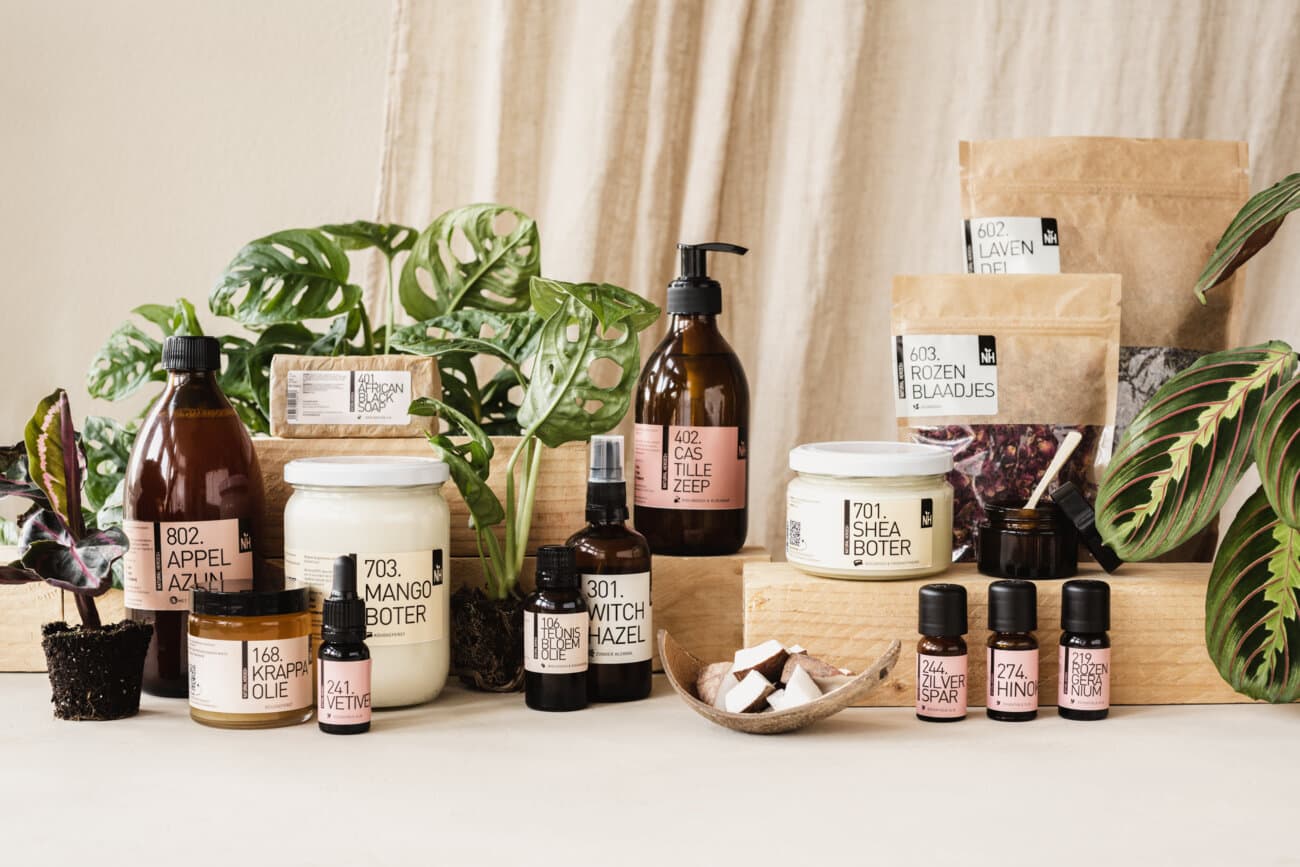
Ready-made products for your natural routine..
Do you want to stay updated on offers, (giveaway) actions and recommendations? This way you won't miss out on anything! Not too often, we promise.


Jojoba oil, argan oil, tea tree oil… there are so many different plant-based oils. Why does your skin need an oil, how do you combine different oils, why does one oil feel so heavy while another does not? And how do you choose the right oil?
Plant-based oil as day and night care – are you using it already? Some people swear by it, while others would rather not think about it (yet). I also had to get used to it: oil for oily skin. Surely that doesn’t work? There are an enormous number of different plant-based oils. Some feel very heavy on the skin and leave a greasy layer behind. Other oils are very light and absorb straight into the skin. Why does our skin need oil? Why is it good to combine different oils, and what should you bear in mind when combining oils?
Your skin is your largest organ. It is not strange at all, then, that your skin needs good care. The function of the skin is to protect against external influences. That is a very important function. You can think of the skin as a protective coat. Is the coat in poor condition? Then you are much more sensitive to external influences such as the weather or hormonal fluctuations. If the coat is in good condition, your skin is better protected against the environment and the chance of moisture loss is at its smallest. How is your coat doing? Is it strong, or rather quite vulnerable?
The skin also produces oil itself in the form of sebum. Sebum is secreted by the sebaceous glands of the skin. These sebaceous glands lie in the second layer of skin, also known as the dermis. Most sebaceous glands are found in places where hair is present, so on the hairy scalp, the face, the chest and the back. They are not present on the palms of the hands, the soles of the feet and the toes. Sebum keeps the skin naturally oily and supple. Sebum also protects the skin against dehydration and moisture loss. Sebum is therefore needed to protect the skin and contributes to a good skin barrier.

Plant-based oils are rich in fatty acids. These nourish the skin and keep its structure healthy. By using oil, you can keep the sebum composition in balance, and thus keep the skin supple, prevent dehydration and so maintain optimal protection. In addition, each oil has its own specific properties: some oils contain many antioxidants, others soothe the skin or have an anti-inflammatory effect.
Sebum production decreases as we get older. We then often develop drier and more vulnerable skin. It is precisely then that it is very important to support your skin with natural oils. But oily, dry and sensitive skin can also make good use of this support.
Dry vs. oily skin
Generally speaking you can say: people with dry skin do not produce enough sebum and people with oily skin produce too much sebum.
Plant-based oils consist of fatty acids that correspond to the fatty acids of sebum. Each oil has a different composition of fatty acids. Every skin has its own specific composition of fatty acids, which different oils suit. For every skin there is an oil combination that works best. It just sometimes takes a bit of time and effort to find the perfect composition.
To make this a little easier for you, we have developed the OIL FINDER developed. This tool is based on extensive data about our oils and which skin type they suit. Through a comprehensive questionnaire you will find out which oils suit your specific skin type. Click the button below to go to the oil finder and try it for yourself!

An oil will support your skin in sebum production so as to keep your skin in optimal condition. This way your skin becomes a perfect coat for your body. Of course, not every oil is suitable for every skin. If you have oily skin or skin with spots, it is best to avoid heavy oils such as Coconut oil. Lighter oils such as Jojoba oil or Grape seed oil are in fact ideal for oily skin. If you have dry skin, the thicker, nourishing oils are very pleasant, such as Sweet Almond oil. Do you have sensitive skin? Then avoid oils that can cause irritation, such as Tea tree oil.
Do you have very sensitive skin? Then it is best to test the oil briefly before use. You do this by massaging a few drops into your elbow. Has no reaction appeared after 24 hours? Then you can assume that no irritation will occur when using the oil.

As written above, the sebum in your skin consists of various fatty acids. The better the combination of fatty acids matches your sebum, the better it is absorbed. Now all that is left is to find the right combination :)
Every oil contains certain nutrients. When you want to care for your skin optimally, it is good to combine different oils. Think, for example, of healthy food. Broccoli is very healthy and contains healthy nutrients. But if you only ate broccoli, at some point you would still miss out on good nutrients, and that is not so healthy at all.
Some oils have a short shelf life, others have a long shelf life. There are also oils that extend the shelf life of oils, think for example of Jojoba oil. By combining different oils you can make very good use of the oils with a shorter shelf life.
Some oils feel very heavy on the skin and leave a greasy layer behind, while other oils are very light and absorb straight into the skin. Why is that? Every oil has a certain speed at which it penetrates the skin. This depends, among other things, on the fatty acids contained in the oil. Some oils stay very superficial in the skin, while others penetrate deeper into the skin. A heavy oil needs more time to penetrate the upper layers of the skin and therefore stays on the skin longer, leaving a greasy layer behind. Often an oil that absorbs quickly does not penetrate very deep into the skin. An oil that does penetrate deep into the skin often absorbs slowly and so leaves a shiny layer on the skin. Ideally, of course, you want an oil that absorbs very quickly and penetrates deep into the skin. For this, combining oils is perfect.
Oils that quickly penetrate the skin are, for example: Prickly pear oil, Rosehip oil, Hemp seed oil and Rice Bran oil. Argan oil and Grape seed oil also absorb into the skin fairly quickly.
Apricot kernel oil, Sweet Almond oil, Safflower oil, Jojoba oil, Sunflower oil, Macadamia oil and Sesame seed oil take a little longer.
Avocado oil, Evening primrose oil, Baobab oil, Borage oil, Olive oil, and Pomegranate oil take a bit longer still.
Neem, Castor oil, and Coconut oil need the longest time.
For the ideal care of your skin, it is best to combine an oil that absorbs quickly with an oil that absorbs slowly and penetrates deep into the skin. As day care you could use more conditioning oils, while as night care you could use somewhat more nourishing and repairing oils. Start with a base oil suitable for your skin type. Is this an oil that absorbs slowly? Then add an oil that absorbs quickly. After that, add another oil that helps to improve the shelf life and keeps the oil from going rancid, such as vitamin E.

Carrier oils can spoil and become degraded. If the taste and smell of an oil have become very unpleasant, you can assume that your oil has gone ‘rancid’. This is caused by exposure to light, oxygen and moisture. It is therefore important always to protect your oils from sunlight and to store the oil at room temperature. You can prevent rancidity by adding an antioxidant. An example of this is Vitamin E Oil. Some oils naturally already contain a great deal of antioxidants and will therefore not go rancid so quickly, Coconut oil for example. Also Jojoba oil, Sesame oil, Rice Bran oil and Apricot kernel oil are rich in antioxidants and often do not need extra Vitamin E.
This of course depends on your wishes and what your skin needs. Have a good experiment with this and above all watch how your skin reacts. A tip? You can of course first use and test different oils pure on the skin. How quickly does the oil absorb? How does your skin feel after applying the oil? How does your skin look after applying the oil? How does your skin feel after cleansing the skin? How does your skin look at the end of the day? Does your skin become shiny, or does it feel drier?
This way you get to know the different oils and you can create an ideal combination.

Have you found the ideal oil combination? After you have added the antioxidant, you can choose to add an Essential oil to it. Not only do they give a lovely scent to your creation, they also bring skin benefits. There are, for example, essential oils that repair, soothe or purify the skin.
Frankincense is, for example, a very nice oil for mature skin, Sweet orange has a purifying effect and Rose geranium a calming one.
Do always pay attention to maximum dosages when using essential oils. As a rule of thumb you can keep to 0.5-1%. For some essential oils an even lower percentage applies. Download the PDF below for the maximum dosages per essential oil.
Written by: Helena Laarman