Ready-made products for your natural routine..
Do you want to stay updated on offers, (giveaway) actions and recommendations? This way you won't miss out on anything! Not too often, we promise.


Essential oil, aromatic oil, volatile oil… all names for the same wonderfully scented product. Each scent has different properties and can therefore be used for various purposes. Use the essential oil in your aroma diffuser or, of course, to give your DIY care or household products a lovely fragrance.
Essential oil, aromatic oil, volatile oil… all names for the same wonderfully scented product. Each scent has different properties and can therefore be used for various purposes. Essential oils can be used for aromatherapy or, of course, to give your DIY care or household products a lovely fragrance.
Essential oils are natural extracts that are distilled from various parts of the plant, such as the blossom, fruit, peel, trees or bark. It often takes hundreds of kilos of plant material to make a litre of essential oil. An essential oil is therefore far more concentrated than the plant from which it originates. For example, 150 kg of lavender flowers are needed for 1 litre of lavender oil. Each oil has a unique composition of active ingredients. This mixture of active substances determines the action and properties of the oil.
You probably know it well: that one scent that takes you back to a lovely experience. You only have to smell the scent and you can recall the experience exactly. Our sense of smell is the strongest sense we have. Did you know that the olfactory receptors in our nose are able to recognise 10,000 scents? These olfactory receptors are directly connected to our limbic system, in other words the emotional brain. Essential oil therefore goes beyond scent alone and is strongly connected with emotions. There are scents that provide wonderful relaxation (for example Lavender, Palo Santo and Vanilla), or there are scents that give you energy and provide more concentration (such as Lemon and Peppermint). Some scents have a positive influence on your sleep (for example Lavender) while other scents in turn have an effect on a positive mood (Turmeric, Sandalwood or Orange).

Essential oil is also known as aromatic, essential or volatile oil. Apart from the names, there is no difference between essential and etheric oil.

Essential oil can be divided into different fragrance notes: top notes, middle notes and base notes. The note of the oil determines how long or short the scent lasts after exposure to oxygen.
Top notes are scents that you smell only briefly, they fade quite quickly (usually within 2 hours).
Middle notes are present longer than top notes.
Base notes are heavy scents and linger for a long time.
Do you want to combine scents? Then it is best to combine top, middle and base notes.
Examples of the different fragrance notes:
Top notes: Citrus oils, Lavender, Bergamot, Eucalyptus
Middle notes: Tea Tree, Rosemary, Geranium, Chamomile, Cinnamon bark, Thyme
Base notes: Ylang-Ylang, Sandalwood, Frankincense, Ginger, Cedarwood, Vetiver
Besides being able to divide essential oils into fragrance notes, they can also be divided into fragrance types:
Floral
Floral scents are, of course, the scents of lovely, sweet flowers. Think of soft floral scents such as Lavender or Chamomile, or rather somewhat heavier floral scents such as Geranium and Ylang-Ylang.
Fruity
Fruity scents for a cheerful mood: such as Orange, Bergamot, Lemongrass, Lemon
Fresh
Fresh scents give a real boost to your energy levels. Citrus scents in particular fall under this, such as Lemon, Mandarin, but also Eucalyptus, Sage and Rosemary.
Woody
Woody scents are above all the earthy, grounding scents. They provide relaxation, a warm feeling and bring you close to nature. You can think here of Sandalwood, Palo Santo, Frankincense, Scots Pine, Hinoki or Cypress.
Spicy
Spicy scents are powerful scents, such as Basil, Juniper or Thyme.
Warm
Warm scents create a cosy, homely atmosphere. You can think here of Cinnamon, Vanilla and Ginger.

Synthetic fragrances are scent substances that have been (re)created by humans, so they do not occur in nature. They are often found in cosmetics, perfumes or even in our food! The advantage of a synthetic fragrance is that the scent does not depend on nature, so the scent can always be reproduced identically. An essential oil is influenced by the ever-changing factors from nature and can therefore differ from one bottle to the next.

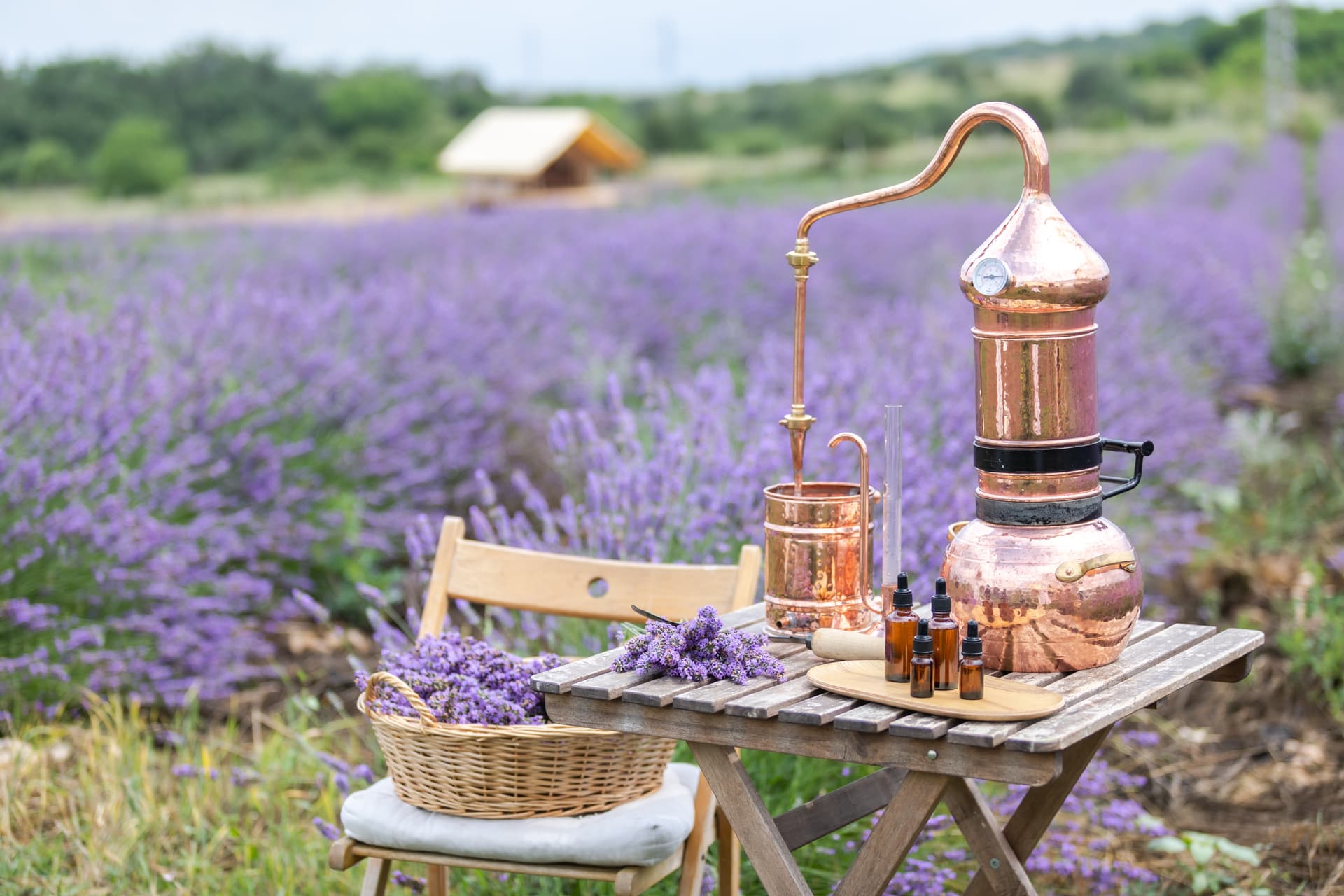
Steam distillation is the most popular method for extracting essential oil from plant material. In a large vat, water is heated, creating steam. The steam is led up from below through the plant material and so extracts all the volatile substances, which rise with the water vapour. After this the steam cools down and the condensation process begins. The condensation then becomes liquid water again, and from this comes part water and part oil. The oil part is then poured off, and this is the essential oil. The water part is what we know as hydrosols. These are therefore a by-product of the distillation process.
CO2 extraction is done without heat; the gas carbon dioxide is used as a solvent. In this process CO2 is brought into contact with plant material under pressure in a tank. Carbon dioxide acts as a solvent under a certain pressure. The pressure draws the oils out of the plant. The essential oil thus dissolves in the liquid CO2. The temperature of the extraction is therefore much lower than with steam distillation, so fewer components are lost. CO2 extraction also extracts waxes and can therefore be somewhat thicker. The scent, incidentally, is somewhat more refined.
Aroma Diffuser
Diffuse essential oil in an easy way with an aroma diffuser. This spreads the scent of essential oil through the room with a gentle mist. It is a humidifier and a fragrance diffuser in one. This way you have a pleasant atmosphere and humid air at the same time!
Inhaling
Of course, you can also inhale directly from the bottle; take a bottle with you in your handbag and your favourite scent is always nearby.
Scent sticks
Make your own scent sticks by pouring a few drops of essential oil into a bottle with oil. Then place a few wooden scent sticks in the bottle and the scent spreads through the space.
Scent spray
Use it as a linen spray, room spray or to freshen up your curtains! Mix a few drops of essential oil with water, shake well and you are done! Note: test this spray before use to check whether any stains appear. You could of course also use a hydrosol for this.
DIY products
Use the essential oil to give a lovely scent to your DIY creations, such as skincare products, hair products, soaps or lotions. Or add essential oil to your favourite carrier oil, such as Almond oil, Jojoba oil or Argan oil. Note: do not apply the pure oil directly to the skin. Keep to a dosage of a maximum of 1% of your final product, then you are always on the safe side!
Perfume
Use essential oil as a perfume. Mix a few drops with a carrier oil, such as jojoba oil, in a roll-on bottle and your homemade perfume is ready. It is best to combine top, middle and base notes.
The lovely thing about essential oils is that you can create new combinations again and again. By mixing different fragrance types you change the scent and strength of an oil. Are you using them at the office, in the living room or on your skin? Make your own blend for every mood!
Written by: Helena Laarman