A subject we don't like to discuss: body odour, and why would we? We'd much rather hide behind a nice-smelling deodorant that also keeps our armpits dry for up to 48 hours.
Problem solved, right...?
Why there's something off about your deodorant
It has become impossible to imagine our daily routine without it: deodorant. We can no longer do without it. We often apply it several times a day to one of our most sensitive bits of skin; the armpits.
Our skin is our largest organ and absorbs substances from outside. And the thin skin of your armpits just happens to be a place where this happens especially easily. The substances your skin absorbs can enter the bloodstream and then end up all over the body.
By now you'll understand that it is therefore not entirely unimportant what exactly you rub onto your skin.
I myself have switched to homemade deodorant and the reason for this is simple but clear. Ordinary deodorant contains all sorts of ingredients that are unnecessary and even harmful. Substances that our armpit skin sadly absorbs easily, ending up in places in the body where they don't belong.
These 5 ingredients in particular are ones you should absolutely try to avoid:
1. Parabens
Parabens can disrupt normal hormone functions, because this substance mimics the action of oestrogen. It binds to oestrogen receptors and in this way causes all kinds of problems. In the ingredients list, parabens are often listed as methyl-, ethyl-, propyl- and butylparabens.
2. Aluminium
The antiperspirant action of deodorant comes from aluminium salts. These absorb moisture and give a dry feeling. Unfortunately our skin then absorbs the aluminium, which thus enters the bloodstream, and the effect on our body is worrying. Aluminium is a metal that causes oxidative stress and can damage cells in our nervous system in particular. Aluminium is usually listed in the ingredients list as aluminium chloride or aluminium hydrochloride. Incidentally, watch out for deodorants at the chemist that say they are 100% natural and consist of one of those little lumps of salt — this is often still aluminium salt!
3. Propylene glycol
Propylene glycol is a substance made from petroleum and is used in cosmetic products as a 'softening', spreadable agent. In deodorant, then, to make your armpits feel softer and smoother. Propylene glycol is linked to liver and kidney damage and is also said to be bad for the heart and nervous system. Other substances made from petroleum are also strongly discouraged. Among the ingredients they can be recognised as petrolatum, vaseline, paraffinum-liquidum, paraffinum-subliquidum cera microcristallina (hard paraffin), microcrystalline wax, mineral oil, ozokerite, ceresin, C 11-12 or C 13-14 isoparaffin.
4. Phthalates
To make deodorant and other cosmetic products blend well, plasticisers — or phthalates — are often added. Unfortunately, the presence of this substance in the blood and urine of pregnant women is linked to birth defects, because, like parabens, it can disrupt the hormonal balance. Phthalates can be recognised by these names: di-2-ethylhexyl phthalate (DEHP), di-isononyl phthalate (DINP), diethyl phthalate (DEP) and dibutyl phthalate (DBP).
5. Triclosan
Triclosan is a white powder with an aromatic scent that has a powerful purifying action. This substance works as an odour fighter, preservative and disinfectant, and so seems an ideal ingredient for a deodorant. But unfortunately, triclosan is also classified as a pesticide.
It was immediately clear to me; I'd be better off getting rid of my deodorant sooner rather than later.
So are there no deodorants for sale that are okay at all?
There certainly are, but for those you usually have to go to a health-food shop. After I had banished conventional deodorant from my bathroom, I initially went to the health-food shop too. The price is unfortunately a bit high, but in terms of ingredients it's definitely good.
Sadly, the natural deodorants didn't work optimally for me and, with my sensitive skin, I still struggled with the amount of alcohol they often contain.
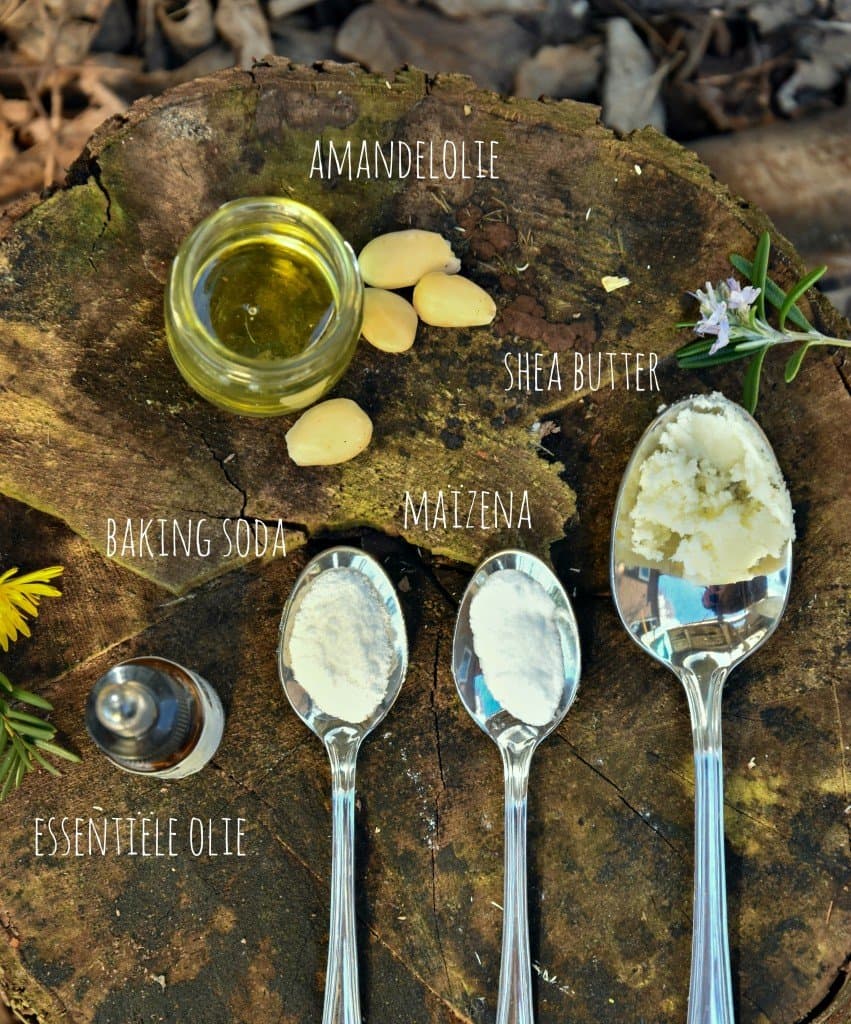
I began experimenting with making my own deodorant and this turned out to be very simple too! With just 5 ingredients you can already make a really good deodorant that smells lovely and keeps you wonderfully fresh.
Ingredients
 You can unsubscribe at any time.